

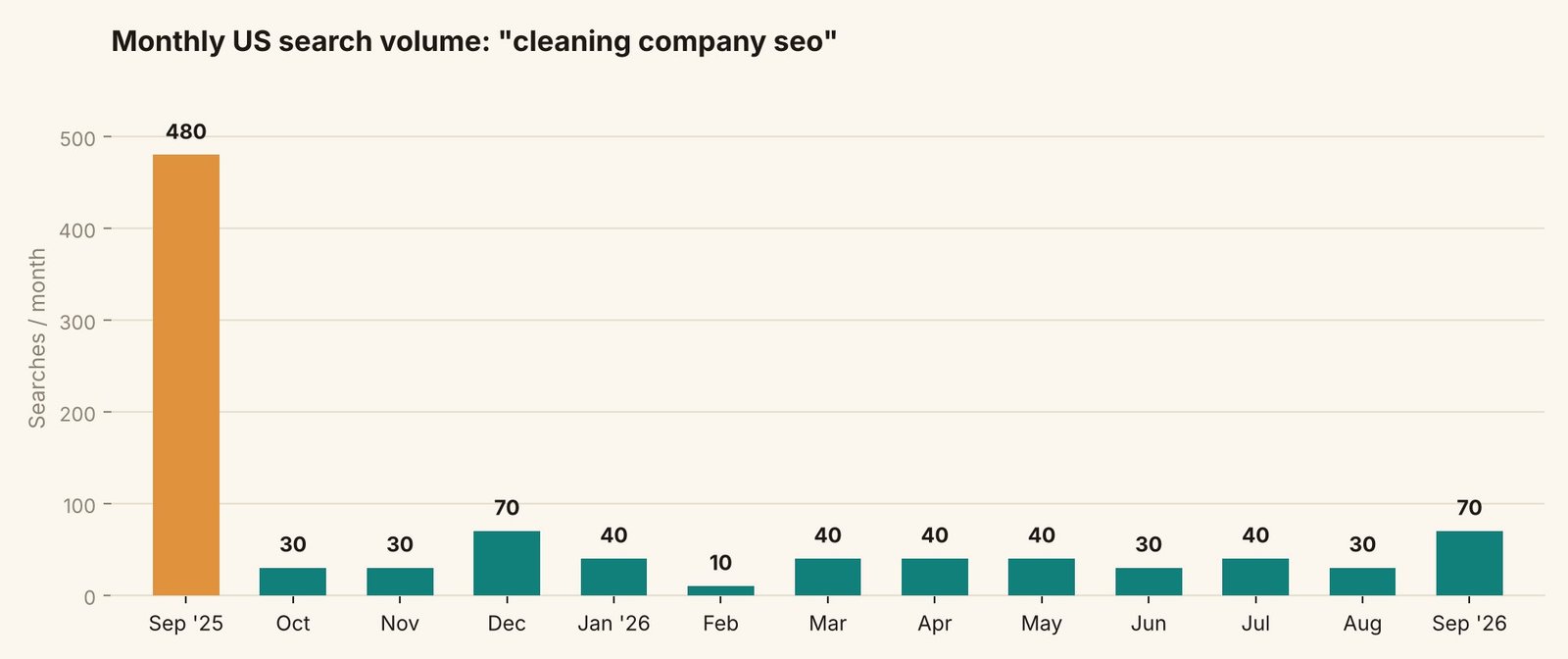
Cleaning company SEO is the work of getting your business to show up in Google’s map pack and organic results when someone nearby searches for a cleaner. For most local cleaning businesses, that depends on three things working together: a complete Google Business Profile, a website built around the services you actually offer, and a steady flow of real reviews. The volume on this exact phrase is smaller than it looks on paper. Cleaning company SEO pulls around 70 searches a month nationally, with a seasonal jump to nearly 480 in September as fall cleanups start. The businesses that rank consistently treat this as a running system, not a one-time setup.
What cleaning company SEO actually covers
Three channels do almost all the work for a cleaning business: Google’s map pack, organic search results, and the directories people check before they call. Map pack visibility comes from your Google Business Profile and how consistent your business information is everywhere else it appears. Organic results come from your website answering the exact question a customer has, residential versus commercial, one-time versus recurring, specialty jobs like carpet or window cleaning. Directories like Yelp and Angi feed both, since Google reads them as a signal that your business is real and active.
Most guides treat these as separate checklists. They are not. A review on Google strengthens your map pack ranking. A detailed service page strengthens the review request that follows a job. Treat the three together and the whole system compounds faster than any one piece working alone, the same principle behind any working SEO content system rather than a list of disconnected tactics.
Research keywords by what the customer is trying to do
Generic, agency-style phrasing gets searched by marketers far more than by actual homeowners, which is why volume on a term like this looks thin on paper. Customers search the way they would describe the problem: “house cleaning near me,” “move out cleaning Denver,” “how often should carpets get cleaned.” Pull these from Google’s autocomplete, from the “people also ask” box on a results page, and from the actual questions your booking form or front desk hears every week.
Group what you find into three buckets before writing anything. Informational questions cover how often, how much, and what’s included. Comparison questions cover one-time versus recurring, or maid service versus deep clean. Ready-to-book searches include a location or “near me.” Each bucket points to a different kind of page, and the ready-to-book bucket is both the smallest pile of keywords and the highest-value one to write first.
Build a Google Business Profile that’s actually complete
A claimed profile and a complete one are not the same thing, and most guides only tell you to do the first. Fill in every category Google offers for your business type, list the specific services you perform under each one, and set your service areas by city or postal code instead of a blanket radius if customers don’t visit your address. Upload real photos of your crew and vehicles instead of stock images, and post an update or offer through Google Posts at least twice a month so the profile shows recent activity.
- Answer your own Q&A section before a customer posts something misleading there
- Respond to every review within a few days, good or bad
- Set hours accurately, including holiday hours, since a wrong “closed” costs calls
- Check the profile on a fixed schedule, weekly is enough, since this is the step every business skips after month one
Keep your name, address, and phone identical everywhere
NAP, short for name, address, and phone number, has one job: match exactly across your website, your Google Business Profile, and every directory you’re listed on. A missing suite number or an old phone number from before you moved doesn’t just confuse a customer. It tells Google your business information can’t be trusted, which quietly caps how far you can rank.
Audit the format you use everywhere, whether that’s “St.” or “Street,” “Inc.” or nothing at all, and standardize to one version. Fix your website and Google Business Profile first since they carry the most weight, then work through Yelp, Angi, Nextdoor, and Bing Places. A tool like Moz Local or BrightLocal can flag mismatches automatically once you have more than a handful of listings to check.
Turn reviews into a system, not a one-off ask
Asking for a review right after a job, while the work is still visible, gets a far higher response rate than a generic email sent a week later. Text a review link within an hour of the appointment ending, then follow up once by email two days later if there’s no response. Keep the message specific: mention the service and the neighborhood, and the reviewer’s natural reply tends to echo it back, which helps both the review’s credibility and your local rankings.
Respond to every review, including the negative ones. A short, professional reply to a bad review often matters more to a future customer than the review itself. What you shouldn’t do is offer a discount for a review or ask for only positive ones. Both violate Google’s review policies and can get reviews removed in bulk if flagged.
Structure your pages by service, not just by city
The easiest mistake in local SEO for cleaning companies is building ten nearly identical city pages that swap out one place name. Google notices, and it will index at most one of them. Build pages around what actually differs instead: residential recurring cleaning, one-time deep cleaning, move-in and move-out cleaning, and any specialty service like carpet, window, or post-construction cleaning. Mention the cities and neighborhoods you serve naturally within each service page, in the text itself and a short service-area list, rather than cloning a whole page per city.
If you truly serve distinct metro areas with different teams, pricing, or availability, a dedicated location page can work. It needs unique content to earn its place: local testimonials, a local phone number where you have one, and specifics about that area, not a find-and-replace on the citywide page.
Add schema so Google and AI tools can verify who you are
LocalBusiness schema is a block of structured data in your page’s code that states your business name, address, phone, hours, and service area in a format search engines and AI tools can read directly, rather than guessing from the page’s text. It’s one of the most skipped steps in cleaning company seo advice, usually named once with no working example. Here’s a minimal version for a cleaning business:
{
  "@context": "https://schema.org",
  "@type": "LocalBusiness",
  "name": "Your Cleaning Company",
  "telephone": "+1-555-123-4567",
  "address": {
    "@type": "PostalAddress",
    "streetAddress": "123 Main St",
    "addressLocality": "Your City",
    "addressRegion": "ST",
    "postalCode": "00000"
  },
  "areaServed": ["Your City", "Neighboring Town"],
  "priceRange": "$$"
}
Add this to your homepage and every service page, with the address and services swapped in each time. It won’t rank a weak page by itself, but it removes any ambiguity for the systems deciding whether your business is a real, verifiable one, which matters more now that AI answers pull from the same structured signals.
Fix Core Web Vitals, then move on
Core Web Vitals get named constantly and explained rarely. Three numbers matter: Largest Contentful Paint under 2.5 seconds, Cumulative Layout Shift under 0.1, and Interaction to Next Paint under 200 milliseconds. Run your site through PageSpeed Insights, which flags the specific images or scripts holding you back. Compressing a handful of oversized photos usually fixes most of the complaint on its own.
These numbers set a floor, not a ceiling. A fast site that answers the question badly still won’t outrank a slower site that answers it well. Spend a day on the obvious technical fixes, then put the rest of your time into the content and profile work above.
Track the right metric in the right tool
Google Analytics and Google Search Console get confused for each other constantly. GA4 tells you what visitors did after they landed: which pages they viewed, whether they called or filled out a form, and which channel sent them. Search Console tells you how you’re actually found: which queries show your site, your average position for each one, and your click-through rate. Neither tool does the other’s job.
For a cleaning company, the numbers that matter are map pack impressions and direction requests from your Google Business Profile, phone calls tagged by source, and form submissions tracked as a GA4 conversion event. Rankings on their own don’t pay the bills. Calls and bookings do.
What a realistic timeline looks like
Most cleaning companies ask one question before anything else: how long will this take. The honest answer comes in stages. The first two to four weeks go to Google Business Profile completion, NAP cleanup, and schema, work that’s mechanical but has to happen before anything else compounds. Weeks five through twelve go to service pages, the review system, and a first round of citations. Map pack movement on easier, lower-competition terms usually shows up somewhere in that three to six month window.
Competitive terms in a crowded metro area can take six to twelve months to move meaningfully, especially against agencies and franchises that have been building their profiles for years. A realistic plan says this upfront instead of promising first-page results in thirty days, which no legitimate SEO process can guarantee.
FAQ
Do I need a website for my Google Business Profile to rank?
No. A profile can rank in the map pack without one, but a website gives you a place to answer questions in depth, collect reviews through your own forms, and rank in organic results too, so it’s worth having even in a map-pack-first strategy.
Is SEO worth it for a small, single-location cleaning company?
Usually, yes. Local search carries less competition than paid ads for the same traffic, and it keeps working after you stop paying for it. A brand-new business should still expect the three to six month timeline above before judging results.
How many reviews do I actually need?
There’s no fixed number, but a business with 20 or more recent, detailed reviews consistently outranks one with five old ones. Recency and detail matter more than hitting a specific count.
None of this requires a marketing degree, but it does require someone checking the profile, the reviews, and the pages on a schedule instead of once at setup. If you’d rather hand that schedule to someone else, Essor’s local SEO service runs this exact system for cleaning companies and similar local businesses, from the first Google Business Profile audit through the monthly review and ranking checks.