

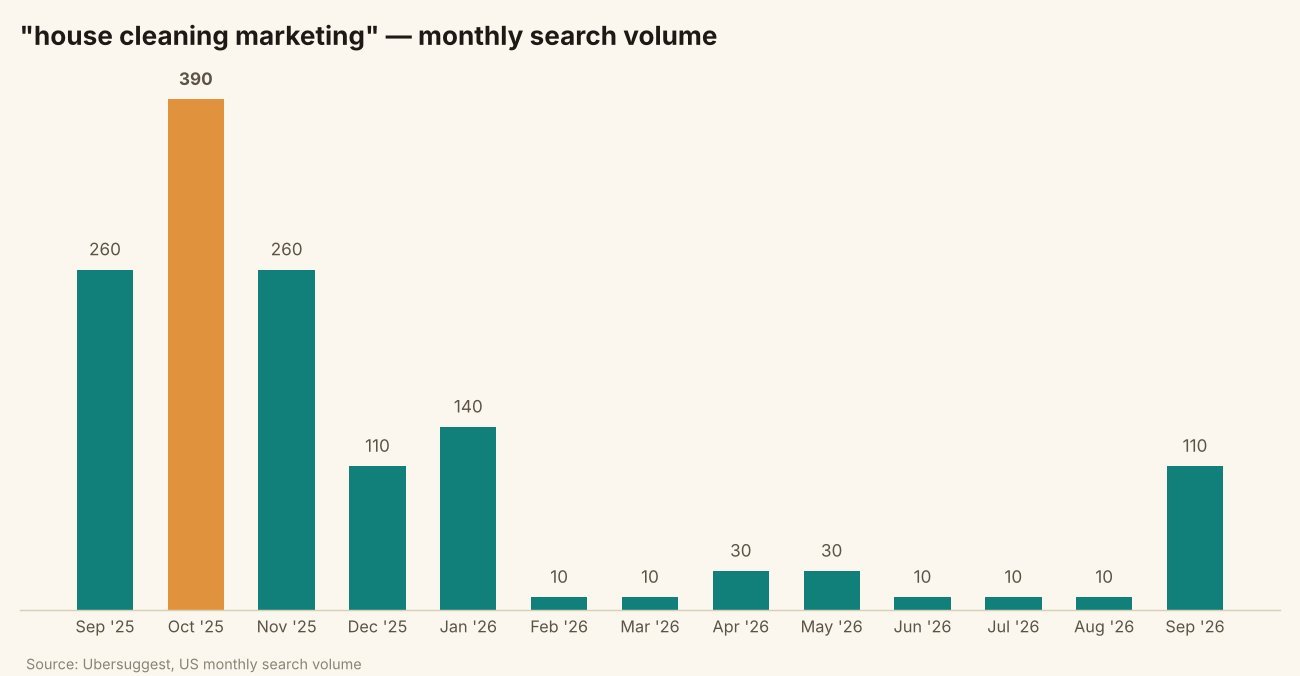
House cleaning SEO works by getting your business in front of people at the moment they’re ready to book recurring service, not just a one-time deep clean. That distinction matters more here than in almost any other home-service niche. A house cleaning or maid service lives and dies on repeat bookings, someone letting the same person into their home every week or two, which means your SEO has to earn trust before it earns a click. Search volume on the exact phrase is small, about 10 searches a month nationally for “house cleaning seo,” but the related term “house cleaning marketing” pulls 110 searches a month with a CPC over $42, a sign that owners actively shopping for help here are worth a lot to the agencies competing for them.
Why house cleaning SEO isn’t the same as cleaning company SEO
A commercial cleaning contractor and a residential maid service both show up under “cleaning” searches, but the customer journey is nothing alike. Someone hiring an office cleaner cares about contracts and compliance. Someone hiring a house cleaner cares about who’s walking through their bedroom while they’re at work. That changes what your website has to prove before a visitor will even think about booking. The broader fundamentals of cleaning company SEO still apply underneath, Google Business Profile, NAP consistency, schema, but a residential service needs to layer trust signals on top in a way a commercial contractor doesn’t.
Trust signals do more work here than almost any keyword choice. Background-checked staff, bonding and insurance, and the same cleaner showing up each visit all answer the real objection standing between a visitor and a phone call. Build your content around that objection first, and the keyword targeting becomes a lot easier to get right.
The recurring-booking funnel changes your keyword priorities
Most maid service revenue comes from weekly, biweekly, or monthly plans, not one-off jobs. That means your highest-value keywords aren’t “house cleaning service” in isolation. They’re the frequency-specific searches: “biweekly house cleaning,” “recurring maid service,” “weekly cleaning plan near me.” These searches carry lower volume individually but convert at a different rate, since the person typing them has already decided they want ongoing help, not a single visit.
Map your service pages to frequency before you map them to room type or add-on service. A page built around “biweekly house cleaning in [city]” answers the exact question a recurring customer is asking, while a generic “house cleaning services” page forces them to dig for the plan that fits their life.
Build local trust signals into every page, not just the homepage
Bonding, insurance, and background checks get mentioned once on an About page and then forgotten everywhere else. That’s a mistake. Repeat the trust signals on every service page and every location page, since a visitor who lands directly on your “move-out cleaning” page from a search result may never scroll to your About section at all.
- State your bonding and insurance status in plain language, not just a badge icon
- Name your background-check process specifically, “every cleaner passes a county and national background check,” rather than a vague “fully vetted”
- Show real team photos instead of stock images of unrelated people in uniforms
- Pair every trust statement with a specific review that backs it up
Google Business Profile needs a recurring-service angle
A Google Business Profile built for a one-time service treats every lead the same way. For a maid service, the profile should nudge visitors toward the booking type that actually keeps your calendar full. List your recurring plans as distinct services inside the profile, not folded into a single generic “house cleaning” entry. Use Google Posts to highlight plan availability during slow seasons, since a recurring client booked in a slow month stays a client in a busy one.
Photos matter differently here too. A commercial cleaner can post equipment shots. A house cleaning service benefits more from photos that make a stranger comfortable with the idea of someone in their home: a clean, organized team vehicle, uniformed staff, before-and-after shots of real rooms with permission from the client.
Reviews need to answer the trust question, not just praise the work
A five-star review that says “great job, very thorough” helps less than one that mentions the specific thing a hesitant customer worries about. Ask clients, in the review request itself, to mention what made them comfortable letting your team into their home. The resulting reviews do double duty: they boost your rating, and they pre-answer the objection for the next visitor reading them before they call.
Respond to every review with the same trust-first framing. A reply to a negative review that explains your vetting process and what changed afterward reassures a reader more than a generic apology does, and it shows up in the same place where a prospective client is deciding whether to book.
Structure your site around service frequency, then location
Most maid service websites make the same structural mistake as general cleaning companies: a page per city with identical content, or a page per room type with no mention of how often a customer actually wants service. Build your primary pages around frequency and service type together: weekly maintenance cleaning, biweekly cleaning, one-time deep cleaning, move-in and move-out cleaning. Mention your service areas naturally within each page rather than duplicating the whole page per neighborhood.
A dedicated location page earns its place only when you can say something unique about that area: a local team based there, a shorter response time, or specific buildings or developments you already service. Anything short of that reads as a thin, duplicate page to both visitors and search engines.
Schema should state your service area and pricing model clearly
LocalBusiness schema matters just as much for a maid service as any other local business, but a few fields deserve extra attention. Set areaServed to the specific cities and neighborhoods you actually staff, not a generic metro radius you can’t realistically serve well. If you run tiered pricing by home size or frequency, consider adding an OfferCatalog block listing those tiers, since both search engines and the newer AI answer tools increasingly look for structured pricing signals rather than guessing from page text.
{
  "@context": "https://schema.org",
  "@type": "LocalBusiness",
  "name": "Your Maid Service",
  "telephone": "+1-555-123-4567",
  "areaServed": ["Your City", "Neighboring Suburb"],
  "priceRange": "$$",
  "makesOffer": [
    {"@type": "Offer", "name": "Weekly Cleaning Plan"},
    {"@type": "Offer", "name": "Biweekly Cleaning Plan"}
  ]
}
Site speed and booking friction compound each other
A slow-loading booking form costs you more in this industry than in most others, because the decision to book recurring home service is already an emotional one. Someone who’s hesitant about letting a stranger into their house doesn’t need an extra ten seconds of spinner to talk themselves out of finishing the form. Run your booking page specifically through PageSpeed Insights, not just your homepage, and fix whatever it flags there first.
Core Web Vitals thresholds stay the same across every niche. Largest Contentful Paint under 2.5 seconds, Cumulative Layout Shift under 0.1, Interaction to Next Paint under 200 milliseconds. What changes for a maid service is which page carries the most consequence when it’s slow, and that’s almost always the booking or quote request form.
Track recurring-client value separately from one-time jobs
Lumping deep-clean one-offs and recurring plan signups into the same conversion metric hides the number that actually matters. Tag recurring plan signups as a distinct GA4 conversion event from one-time bookings, and watch which keywords and pages feed each. A page ranking well for “move out cleaning” might drive plenty of traffic while contributing nothing to recurring revenue, which changes how much SEO effort it deserves relative to a lower-traffic page built around biweekly plans.
Search Console tells a related but separate story: which frequency-specific queries are showing impressions without clicks. That gap often points to a title tag or meta description that doesn’t yet speak to the recurring-booking intent behind the search.
FAQ
Does a maid service need different SEO than a commercial cleaning company?
Yes, in priority if not in mechanics. The technical steps overlap, Google Business Profile, schema, reviews, but a residential service needs trust signals and frequency-based content front and center in a way a commercial contractor doesn’t.
How long before house cleaning SEO shows results?
Expect the same general timeline as other local service SEO: profile and technical fixes in the first month, service pages and review systems building through month three, with map pack movement on lower-competition terms often visible by month four to six.
Is it worth targeting “house cleaning seo” directly as a keyword?
Not really. That phrase is searched by marketers and agencies, not homeowners. Your actual customers search by task and frequency, “weekly house cleaning near me,” “move out cleaning quote,” and those are the terms worth building pages around.
Trust is the real ranking factor in this niche, even though no algorithm names it directly. Every piece above, from the reviews to the schema to the page structure, exists to answer the same question a stranger asks before letting your team into their home. If you’d rather have that system built and maintained for you, Essor’s local SEO service handles exactly this kind of recurring-service business, from the first trust audit through the ongoing review and ranking checks.