

The best SEO for dry cleaners focuses on proximity and routine, not broad keyword volume. Nobody searches “dry cleaner” out of curiosity.
They search it because they’re holding a stained jacket or standing near their commute. Or they’re planning around a wedding and want the closest reliable option right now.
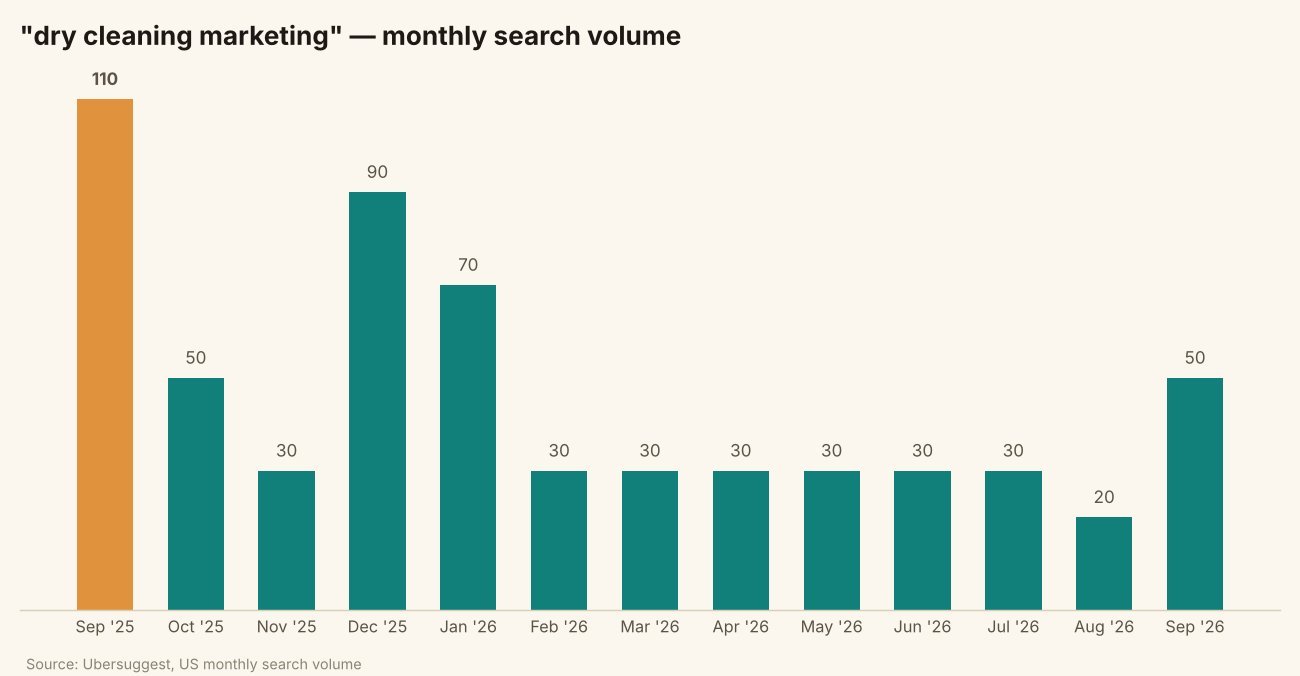
The exact phrase “dry cleaner seo” barely registers in search data. “Dry cleaning marketing,” the term agencies use, pulls just 50 searches a month at a $109 cost per click.
That gap tells you something. This is a low-search-volume, high-stakes niche. Getting found in the right three-block radius matters more than ranking nationally.
Dry cleaning is a proximity business
A house cleaner can serve an entire metro area. A dry cleaner mostly can’t. Customers choose based on what’s near their home, their office, or a route they already drive.
That means your Google Business Profile matters more here than almost any other keyword decision. So does your exact physical location.
Pull up the local pack for a dry cleaning search in any city. You’ll see actual dry cleaning businesses ranking directly, not blog content. Google already treats these searches as hyper-local and map-driven.
That proximity bias changes your whole SEO priority list. Spend less time worrying about ranking a blog post nationally.
Spend more time making sure your profile, your hours, and your exact location are flawless. That’s what decides whether you show up in the three-mile radius that accounts for nearly all your real customers.
Get your Google Business Profile right
Get your categories right before anything else on the profile. Google’s guidelines are clear: a category should describe what your business is, not list out services as keywords.
Skip padding the list to look more comprehensive than you are.
- Primary category: “Dry cleaner” is the category built for this exact business.
- Secondary category, if it applies: “Laundry service,” only if you run wash-and-fold alongside dry cleaning.
- Secondary category, if it applies: “Eco-friendly dry cleaner,” only if that’s actually how you clean, not an aspirational label.
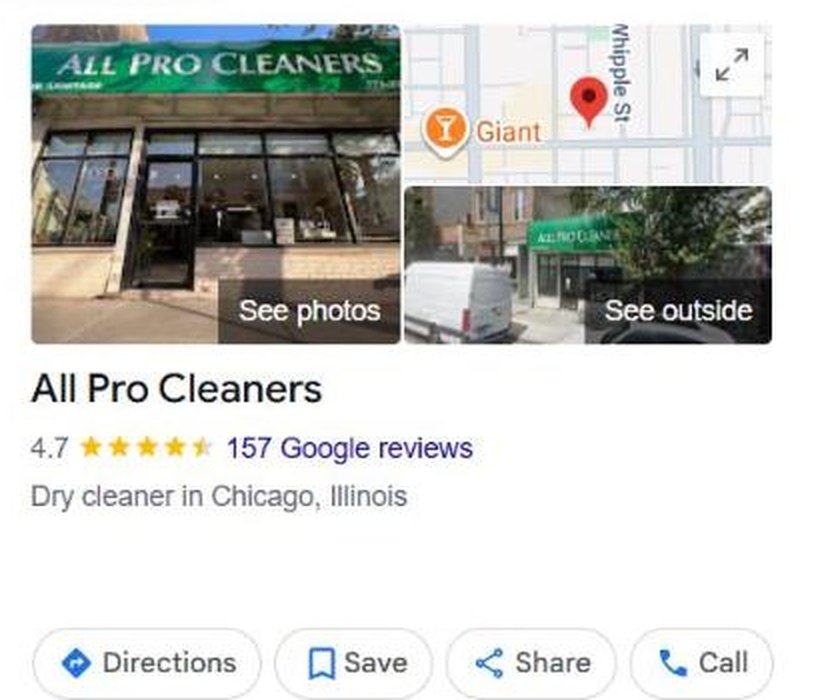
Unlike a house cleaner or a maid service, a dry cleaner is almost always a storefront business. Customers walk in to drop off and pick up.
Your address should stay visible, not hidden the way a service-area business sets it up. That only holds if the location has a staffed counter and real signage during your stated hours.
An address nobody can actually walk into for drop-off is a mismatch. Google can treat that mismatch as grounds for a suspension review, not extra local trust.
The business description has no room for padding. Two or three sentences on what you clean, your specialty services, and the area you serve is enough.
Use the natural phrase a customer actually searches, not a stuffed keyword list. According to Ubersuggest, “same day dry cleaning” gets about 6,600 searches a month nationally. “Wedding dress cleaning” gets about 8,100.
If one of those genuinely describes your business, working it into a single natural sentence is enough. Don’t force both, and never repeat either one more than once.
Here’s what to avoid:
- No links of any kind: Google’s guidelines ban them outright.
- No sale, coupon, or price as the opening line: this counts as a policy violation, not just weak copy.
- No stacked neighborhood names or repeated “dry cleaner near me” phrases: Google names this exact pattern as grounds for suspension.
List your actual hours precisely, including early drop-off and late pickup windows if you offer them. A customer choosing between two dry cleaners three blocks apart cares about one thing most. Which one is open when they can actually get there.
If street parking is tight, mention it in a Google Post instead of the description. The description field has too little room for anything beyond what you clean and where.
A five-minute errand that turns into a parking hunt still sends someone to a competitor next time.
- List pickup and delivery service as a distinct attribute if you offer it, not buried in the description
- Keep holiday hours updated weeks in advance, since dry cleaning demand spikes right before major events
- Respond to every review mentioning turnaround time, since speed is the single most-cited factor in dry cleaner reviews
- Post seasonal reminders through Google Posts: coat storage in spring, wedding dress preservation after June, holiday rush cutoffs in December
Research your own keywords for free
You don’t need a paid tool to find the keywords your own customers actually type. Start with Google’s autocomplete: type “dry cleaner” into a search box and read what Google suggests before you finish typing.
The “People also ask” box on a real search results page is the next-best free source. It shows the actual follow-up questions real searchers had.
- Google autocomplete: free, built into the search bar, shows real phrasing in real time.
- “People also ask”: free, shows on most Google results pages, reveals follow-up questions.
- Google Trends: free, shows whether a phrase is rising or falling, and compares regions.
- Ubersuggest’s free tier: a limited number of free searches a day, shows estimated monthly volume.
A few real examples for this niche, pulled from Ubersuggest:
- “24 hour dry cleaner near me”: about 4,400 searches a month
- “eco friendly dry cleaner near me”: about 1,900 searches a month
- “dry cleaner near me open on sunday”: about 1,900 searches a month
Use these to decide what to write about, not just what to stuff into a sentence. A page on Sunday hours or 24-hour drop-off answers a real, searched question.
A page padded with ten keyword variations of “dry cleaner near me” answers nothing.
Write about your specialty services
Wedding gown preservation, leather and suede cleaning, and corporate uniform contracts carry far more search and revenue value than a generic “dry cleaning services” page ever will.
These are also the services your average competitor skips writing about entirely. That makes them some of the easiest keyword gaps to fill well.
Take wedding dress cleaning and preservation. A dedicated page with real specifics about the process and timeline answers exactly what a bride’s family is searching for.
They’re searching with intent to book, not just browse.
Corporate and uniform contracts deserve the same treatment from the other direction. A business owner searching for uniform cleaning service wants pricing structure, pickup logistics, and account management.
They don’t want a consumer-facing page about getting red wine out of a silk blouse. Separate these audiences into their own pages instead of cramming both into one generic services list.
Use “near me” and commute language
Customers think in terms of their daily route, not formal neighborhood names. Someone searching isn’t typing the official name of a district.
They’re thinking “dry cleaner on my way to work” or “near the train station.” Your copy should speak that same way.
Mention real landmarks, cross streets, and transit stops naturally in your location description and About page. That’s the language Google increasingly matches against real search behavior.
Keep a short, specific list of nearby landmarks and transit points on your contact page too. It does double duty.
It helps a first-time visitor know exactly where to find you. And it gives search engines unambiguous local context beyond your street address alone.
Turnaround time builds trust and rankings
Same-day and next-day service isn’t just a selling point. It’s one of the most frequently mentioned details in dry cleaner reviews.
That means it shows up constantly in the review text search engines read. Search engines use that text to decide how relevant and trustworthy your business is.
State your actual turnaround times clearly on your website and profile, not a vague “fast service” claim. Encourage reviewers to mention specifics.
“Had my suit back in 24 hours before an interview” does far more work than a generic five stars.
Build a short FAQ section around turnaround specifically. These are exactly the questions a stressed, time-pressed customer searches right before deciding which dry cleaner to call:
- How fast is standard service?
- What does rush service cost?
- Is same-day available, and for which item types?
Add schema for your specialty items
LocalBusiness schema works the same way for a dry cleaner as for any local business. Add one thing most competitors skip: a makesOffer block naming your specialty services directly.
This gives search engines and AI tools a clear signal. They learn exactly what you handle beyond standard dry cleaning, instead of guessing from page copy alone.
{
  "@context": "https://schema.org",
  "@type": "LocalBusiness",
  "name": "Your Dry Cleaners",
  "telephone": "+1-555-123-4567",
  "address": {
    "@type": "PostalAddress",
    "streetAddress": "123 Main St",
    "addressLocality": "Your City",
    "addressRegion": "ST"
  },
  "makesOffer": [
    {"@type": "Offer", "name": "Wedding Gown Preservation"},
    {"@type": "Offer", "name": "Leather and Suede Cleaning"},
    {"@type": "Offer", "name": "Corporate Uniform Service"}
  ]
}
Fix site speed for mobile searches
A dry cleaning search is almost always made on a phone, often while someone is already out running errands. A slow-loading hours page costs you a customer standing nearby with five minutes to spare.
So does an address that doesn’t trigger a one-tap map link. Test your site specifically on mobile through PageSpeed Insights.
Make sure your address links directly to Google Maps or Apple Maps, not plain text.
The same Core Web Vitals thresholds apply here as anywhere else:
- Largest Contentful Paint under 2.5 seconds
- Cumulative Layout Shift under 0.1
- Interaction to Next Paint under 200 milliseconds
For a dry cleaner, the page most likely to lose a customer over slow load time is your hours and location page. Prioritize fixes there first.
How long this actually takes
- Weeks 1-4: profile completion, schema, and NAP consistency across directories. This is the same mechanical groundwork every local business needs.
- Weeks 5-10: specialty service pages and a review-request system targeting turnaround and trust.
This niche runs on proximity above almost everything else. A well-optimized profile in a less competitive area can move in the map pack faster than in a crowded one.
Sometimes that’s within two to three months, rather than the longer timelines typical of broader local SEO work.
Dense urban markets with several dry cleaners on the same block are the exception. There, differentiation through specialty services and review specificity matters more than technical SEO alone.
The technical basics are likely already in place across most competitors.
FAQ
Is it worth building out blog content for a dry cleaner’s website?
Selectively, yes. Specialty-service content, wedding gown care, seasonal coat storage, works well because it answers a real, searched question. Generic “benefits of dry cleaning” posts rarely earn their keep in such a proximity-driven niche.
Does a dry cleaner need to rank for broad terms like “dry cleaning near me”?
That phrase matters, but it’s largely won through Google Business Profile completeness and proximity, not website content. Put your SEO effort into the profile and specialty pages instead.
How many locations’ worth of content should a multi-location dry cleaner build?
One well-built page per real location, each with its own hours, parking notes, and a profile of its own. Duplicate content across locations with only the city name swapped tends to get only one page indexed.
Dry cleaning SEO is about precision, not volume. That means the right profile details and the right specialty pages. It also means reviews that mention exactly what a nearby, time-pressed customer cares about.
Managing all of that consistently takes real time. If that’s not where you want to spend yours, Essor’s local SEO service runs this exact system for proximity-driven dry cleaners. That includes profile audits, ongoing review management, and ranking checks.